

Working paperMethodology

GenovaX β€” AI-Designed Nanobody Binders Against a Benchmark Target (Methodology Demonstration)

Dr. Benazir B. Oluoch, Planckchron Research2026

Executive abstract

What this paper proposes.

GenovaX is Planckchron's AI-assisted, computational (dry-lab) drug-discovery workflow. In this demonstration we ran de novo nanobody (VHH) binder design against hen egg-white lysozyme β€” a standard, well-characterized structural-biology benchmark target (NOT a Planckchron therapeutic target) β€” end-to-end on GPU cloud in ~4 minutes, producing a ranked, reproducible shortlist. Every number is a model prediction; none of these molecules has been expressed or assayed.

Methodology

De novo VHH binder generation with an AI-assisted structure prediction and scoring stack (Boltz), followed by developability filtering using Therapeutic-Antibody-Profiler-style sequence/structure heuristics. Ten designs ranked on binding confidence; interactive 3D structures shown for the top two.

Conclusion and boundary

Computational predictions only. Lysozyme is a benchmark target, not a therapeutic program. Advance R7gl as sole lead; hold 33Tc pending liability-removal engineering; keep So7D as a clean backup. Next step: wet-lab validation of the top candidates.
Computational biology Β· Flagship Β· Research-stage

Ranked shortlist (10 designs, by binding confidence)

RankDesignBinding confidenceInterface ipTMDevelopability
1R7gl (lead)0.370.87A β€” clean
233Tc0.250.85C β€” moderate
3So7D0.0770.81A β€” clean
4zJN80.0490.75B β€” minor
5XMpG0.0240.41B β€” minor
6lGE80.0080.81B β€” minor
7KbGM0.0070.76B β€” minor
88f6e0.0030.88A β€” clean
95zNN0.00010.50A β€” clean
10xSWP0.000000.39C β€” moderate

Binding confidence spans ~0.37 to ~0, so the model discriminates rather than rubber-stamps. Design 8 has the highest interface/fold confidence but near-zero binding confidence β€” which is why the shortlist ranks on the binding objective, not any single metric.

Lead candidate β€” R7gl

GenovaX Β· computational prediction

R7gl (lead)

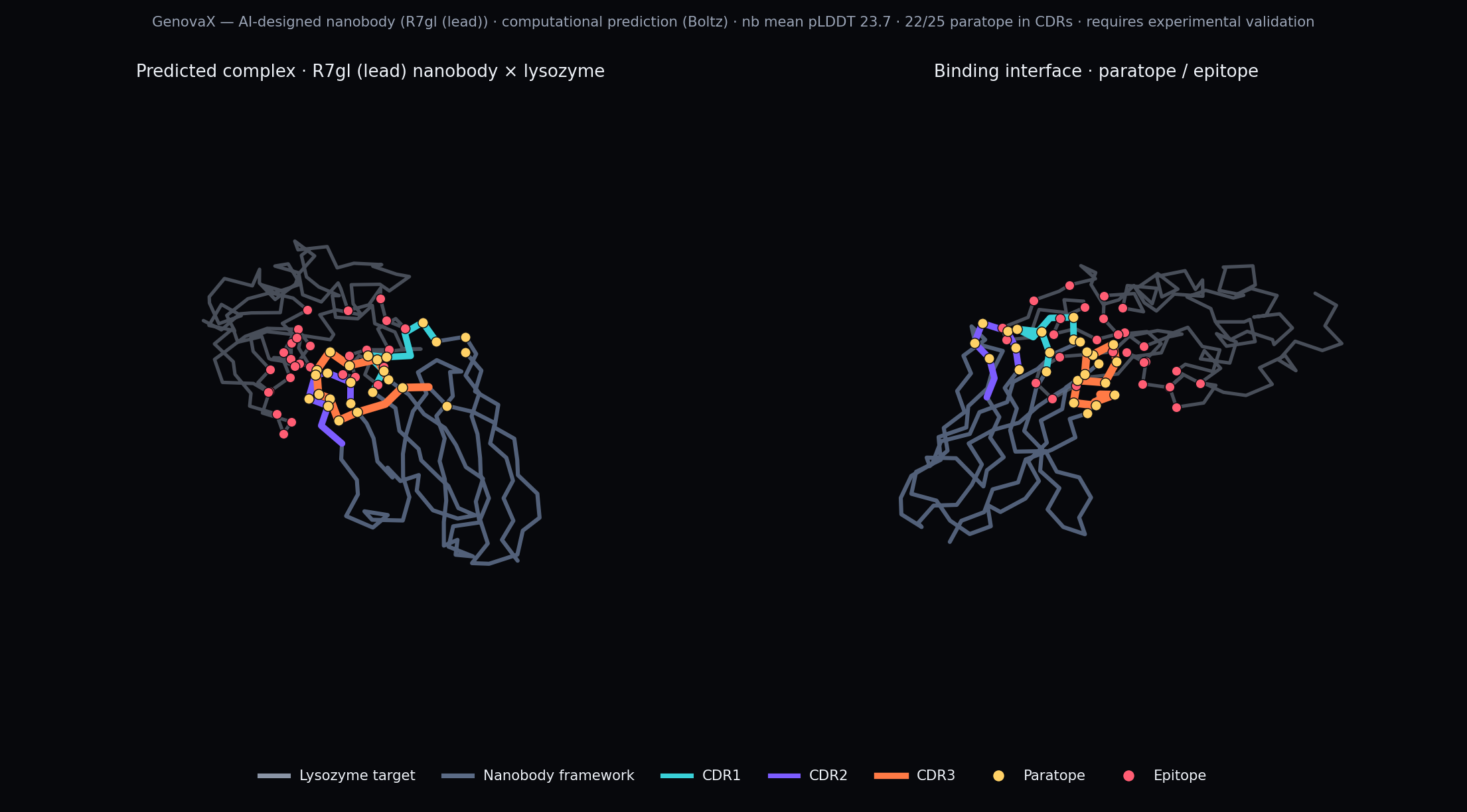
R7gl (lead) computationally predicted nanobody and target complex

Domain overview

Rendered view of the predicted target and nanobody complex with the structural regions identified in the underlying analysis.

Predicted metrics

Binding confidence
0.37 (top of 10)
Interface ipTM
0.87
Nanobody mean pLDDT
~85
Paratope in CDRs
22 / 25
Developability
Grade A (clean)

Predicted contact sets

Paratope residues
25
Epitope residues
28

Underlying model file

Download predicted CIF
Computational prediction only. This is not an experimentally solved structure and does not establish binding, clinical, diagnostic, safety, or efficacy performance. Wet-lab validation is required.

Predicted binding is CDR-driven β€” 22 of 25 paratope residues fall in the CDR loops. Clean developability profile (no CDR liabilities; only the 2 canonical cysteines).

Second candidate β€” 33Tc

GenovaX Β· computational prediction

33Tc

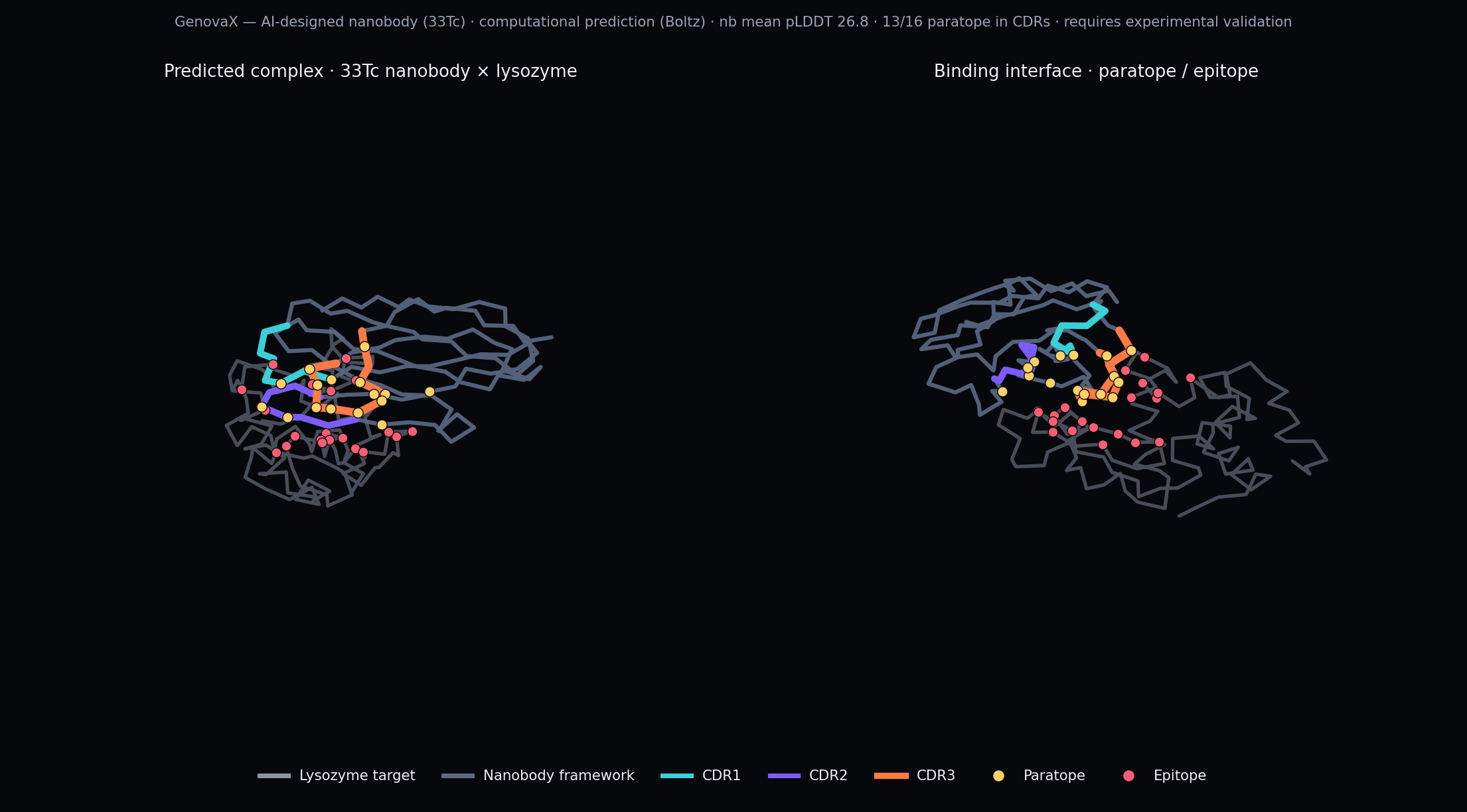
33Tc computationally predicted nanobody and target complex

Domain overview

Rendered view of the predicted target and nanobody complex with the structural regions identified in the underlying analysis.

Predicted metrics

Binding confidence
0.25 (#2 of 10)
Interface ipTM
0.85
Nanobody mean pLDDT
~85
Paratope in CDRs
13 / 16
Developability
Grade C (moderate)

Predicted contact sets

Paratope residues
16
Epitope residues
20

Underlying model file

Download predicted CIF
Computational prediction only. This is not an experimentally solved structure and does not establish binding, clinical, diagnostic, safety, or efficacy performance. Wet-lab validation is required.

Strong binder but developability filtering flags three CDR liabilities β€” including an N-glycosylation sequon inside a CDR, plus a deamidation site and an oxidation-prone methionine in a CDR β€” so it is a conditional #2 pending liability-removal engineering.

Developability filtering (why the ranking changed)

We screened all designs for standard antibody manufacturability liabilities β€” CDR N-glycosylation sequons, deamidation/isomerization motifs, oxidation-prone Met/Trp, extra cysteines, charge/pI, hydrophobicity (Therapeutic-Antibody-Profiler-style heuristics, not lab assays). The lead R7gl is best on BOTH binding and developability; the #2 by binding (33Tc) was demoted to conditional because of CDR liabilities. Revised recommendation: advance R7gl as sole lead; hold 33Tc pending engineering; keep So7D as a clean backup.

Honest limitations & next steps

  • In-silico only; no expression, purification, or affinity has been measured.
  • Absolute binding-confidence values are modest (top ~0.37); rank-order is the useful signal, not the magnitude.
  • Lysozyme is a well-characterized structural-biology benchmark, not a Planckchron therapeutic target.
  • Next step: wet-lab validation of the top 2–3 candidates (express β†’ SPR / BLI / ELISA).
  • Computational predictions require experimental validation. Not medical, clinical, or investment advice.